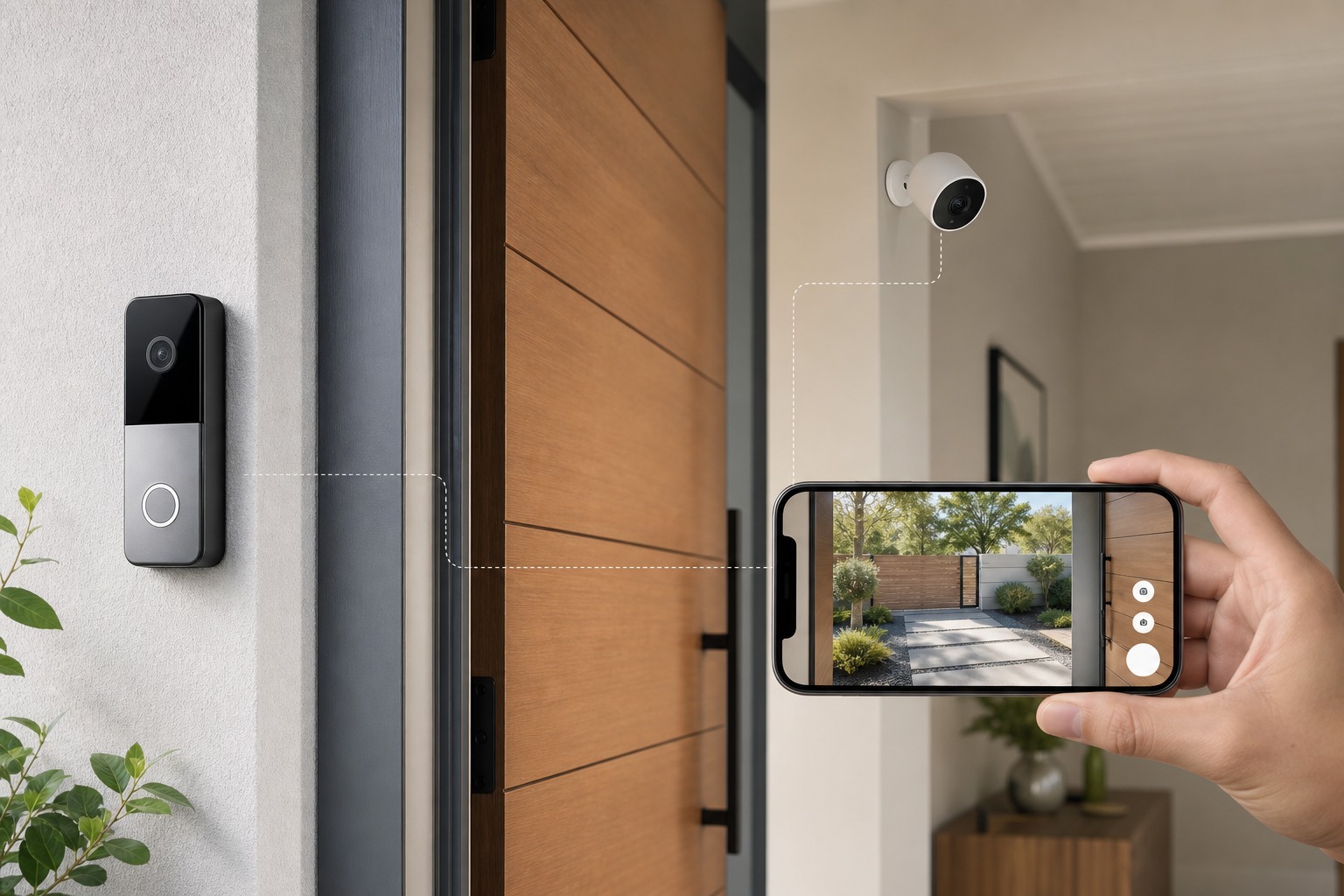
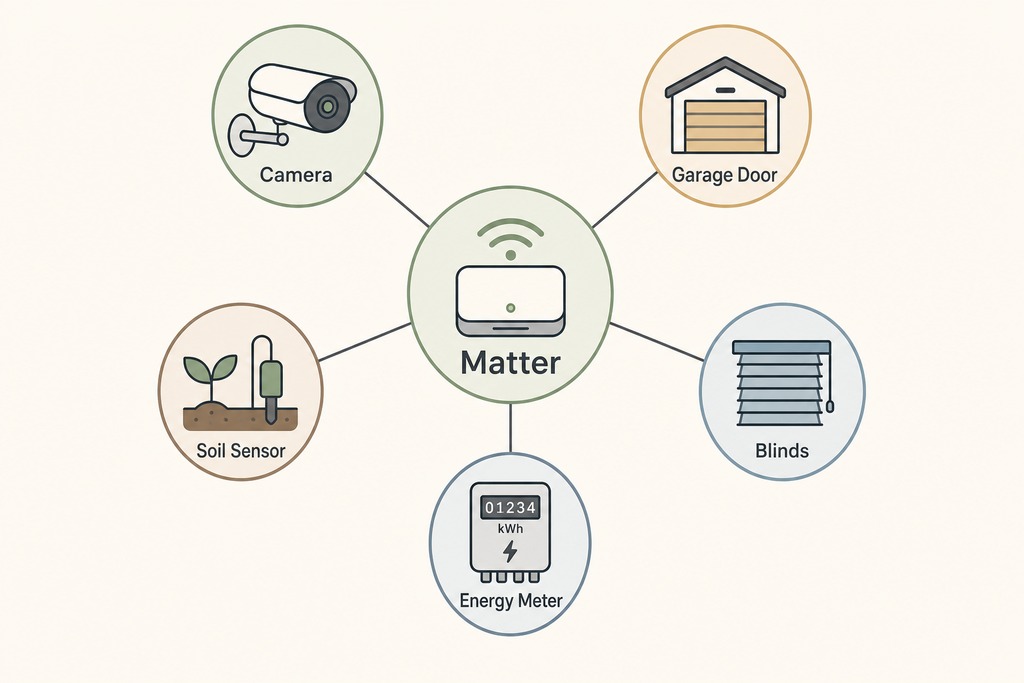
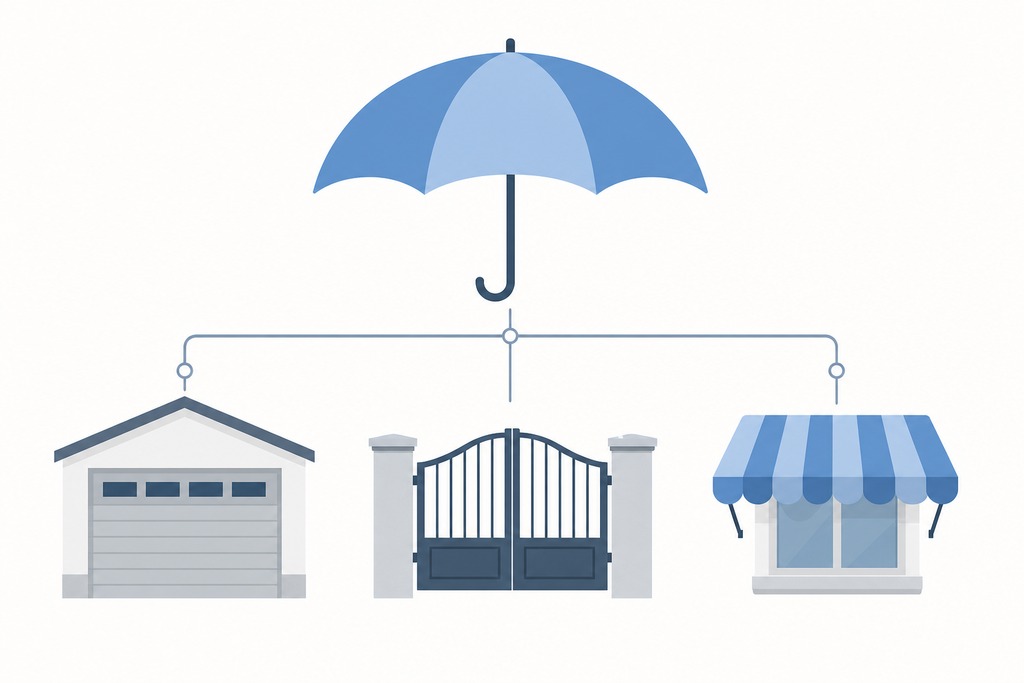
Waiting for Matter to finally handle cameras? Matter 1.5 is the release that added them. Published on November 20, 2025 by the Connectivity Standards Alliance, its headline addition is standardized cameras and video doorbells: the device category Matter had lacked since it launched in 2022. Alongside cameras it added a unified "closures" group (garage doors, gates, blinds, drapes, awnings, and smart windows), soil sensors, much deeper energy management, and full TCP transport for large data.
Run into older articles calling Matter 1.5 an early-2025 update about water shut-off valves, irrigation controllers, and pool equipment? Ignore them: that was pre-release guesswork that never shipped. One more honesty check: as of mid-2026, Matter 1.5 is no longer the newest version. Matter 1.5.1 (March 31, 2026) and Matter 1.6 (June 17, 2026) followed it. Treat 1.5 as the release that introduced cameras, not the current cutting edge.
What Matter 1.5 is (and what it isn't)
Matter 1.5 is the smart-home connectivity standard's fall 2025 major release, published by the Connectivity Standards Alliance (CSA) on November 20, 2025. It keeps the group's twice-yearly cadence and follows Matter 1.4 from November 2024.
Matter 1.5 is the version of the CSA's cross-ecosystem smart-home standard, released November 20, 2025, that added native support for cameras and video doorbells, a unified closures device category, soil sensors, and expanded energy management. It runs over Wi-Fi, Thread, and Ethernet and works across Apple Home, Google Home, Amazon Alexa, and Samsung SmartThings.
Two things need correcting here. First, a run of pre-release articles predicted 1.5 as a water-and-outdoor update built around shut-off valves, irrigation controllers, and pool and spa gear. That version never happened. The real 1.5 is about cameras, closures, soil sensors, and energy: and its only water-adjacent addition is the soil sensor, which triggers watering through Matter valves and irrigation you already own rather than defining those valves as new device types. Second, 1.5 is not the current spec: 1.5.1 and 1.6 came after it.
Matter 1.5 Smart Home Standard
As a standard, the biggest thing 1.5 had to get right was carrying data far more sensitive than an on/off command. Its answer is encryption: the two-way audio and video from a Matter 1.5 camera is scrambled in transit rather than sent in the clear — the kind of plumbing that rarely makes a feature list but decides whether the new device types are safe to trust.
Major New Features in Matter 1.5
Of the new device types, closures are the most flexibly modeled. Beyond the motion styles Matter already understands, 1.5 describes a closure's panel layout in three arrangements — single, dual, and nested — so a single moving panel and a set of stacked ones can be handled by one common definition.
What Matter 1.5 Brings (Key Focus Areas)
Look past the individual gadgets and 1.5's focus lands in two places a household actually notices: the parts of a home that physically move or open, and the systems that draw power and cost money. That is a different center of gravity from the indoor lighting and climate control the standard started with, and it is why a single release now reaches from the edges of your property to the meter on the wall.
Matter 1.5 at a glance
The core facts, before the detail: a fall 2025 CSA release whose defining change is cameras, now already one revision behind.
| Detail | Value |
|---|---|
| Release date | November 20, 2025 |
| Developed by | Connectivity Standards Alliance, with Apple, Google, Amazon, Samsung, and 300+ member companies |
| Predecessor | Matter 1.4 (November 2024) |
| Update cadence | Twice yearly, spring and fall |
| Headline feature | Cameras and video doorbells |
| Current status | Superseded by 1.5.1 (March 2026) and 1.6 (June 2026) |
Matter version timeline
Matter has shipped roughly every six months since October 2022, and 1.5 is the point where cameras finally entered the standard. The current newest release is Matter 1.6.
| Version | Release date | Key additions |
|---|---|---|
| 1.0 | October 2022 | Standard launches: lighting, locks, thermostats, blinds, sensors, bridges |
| 1.4 | November 2024 | Solar panels, home batteries, heat pumps, water heaters |
| 1.4.2 | June 27, 2025 | Maintenance and refinements |
| 1.5 | November 20, 2025 | Cameras, closures, soil sensors, expanded energy, TCP transport |
| 1.5.1 | March 31, 2026 | Multi-stream video, HEIC codec, HLS/DASH streaming, improved PTZ |
| 1.6 | June 17, 2026 | Current newest release |
What's new in Matter 1.5
Five things changed at once, and cameras are only the most visible. Here is the full set side by side.
| Feature area | What it adds | Why it matters |
|---|---|---|
| Cameras & video doorbells | Live video and audio, two-way talk, pan/tilt/zoom, recording, local and cloud storage | First native, cross-ecosystem camera support in Matter |
| Closures | Unified model for garage doors, gates, blinds, drapes, awnings, and smart windows | Consistent position control across brands, not just locks and shades |
| Soil sensors | Soil-moisture and optional temperature readings | Automates watering through Matter valves and irrigation without a proprietary app |
| Energy management | Real-time and forecast pricing, tariffs, grid carbon intensity, bidirectional EV charging | Schedules loads around price, carbon, and grid connection limits |
| TCP transport | Full TCP support for large messages | Carries camera streams, images, and faster firmware updates |
The energy work is deeper than the earlier solar-and-battery reporting in Matter 1.4. An Electrical Energy Tariff device now exchanges pricing, tariffs, and grid carbon intensity between utilities and home devices, so an energy manager can decide when to run an appliance or charge a car based on cost and emissions, not just switch it on.
Cameras and video doorbells
Cameras are why most people are reading about Matter 1.5, because this is the category the standard went without for its first three years. The spec defines a full set of capabilities:
- Live video and audio over WebRTC, the streaming standard W3C and IETF adopted in 2021
- Two-way audio for talk-back at a door or a room
- Local and remote access using STUN/TURN
- Multiple simultaneous streams
- Pan, tilt, and zoom control
- Motion detection and privacy zones
- Continuous or event-based recording
- Local and cloud storage: the first Matter version to permit direct cloud uploads, where earlier releases stored footage locally only
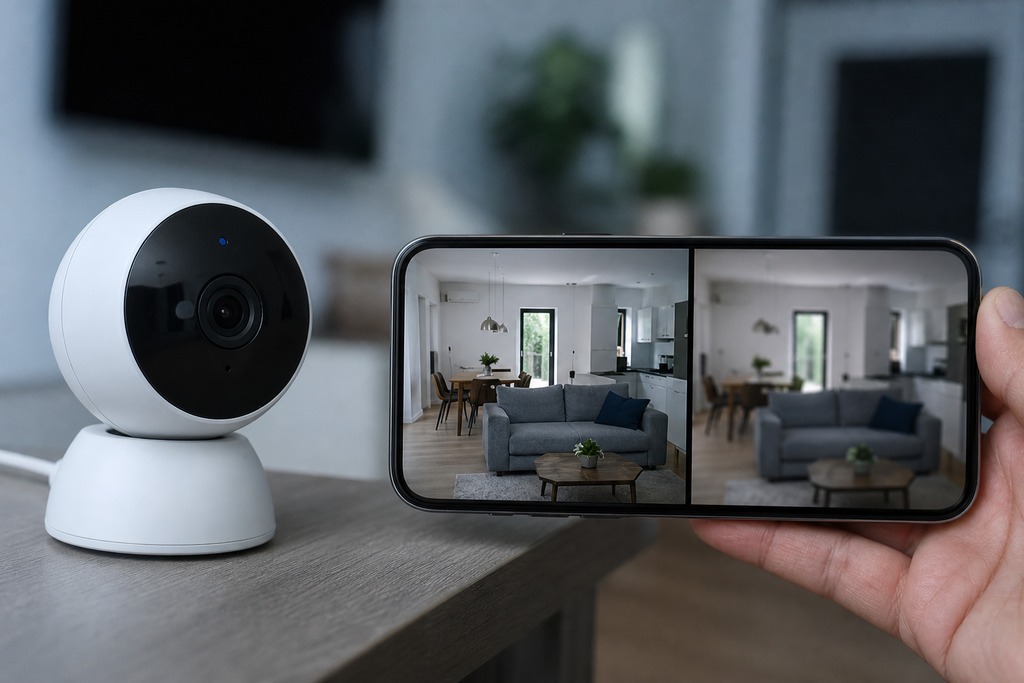
Streaming runs primarily over WebRTC; a secondary RTSP path appears in some accounts, but WebRTC is the defined standard to build against. One caveat matters for buyers: Matter standardizes the interoperable core, so a 1.5 camera will show live video and basic controls in any supporting app. Manufacturers can still keep advanced detection, longer cloud retention, or AI features inside their own apps and subscriptions. Think of a universal remote: it works the basic buttons on any TV, but the maker's special menus stay locked in their own app. Standardized does not mean every feature is exposed everywhere.
When you can actually buy Matter 1.5 devices
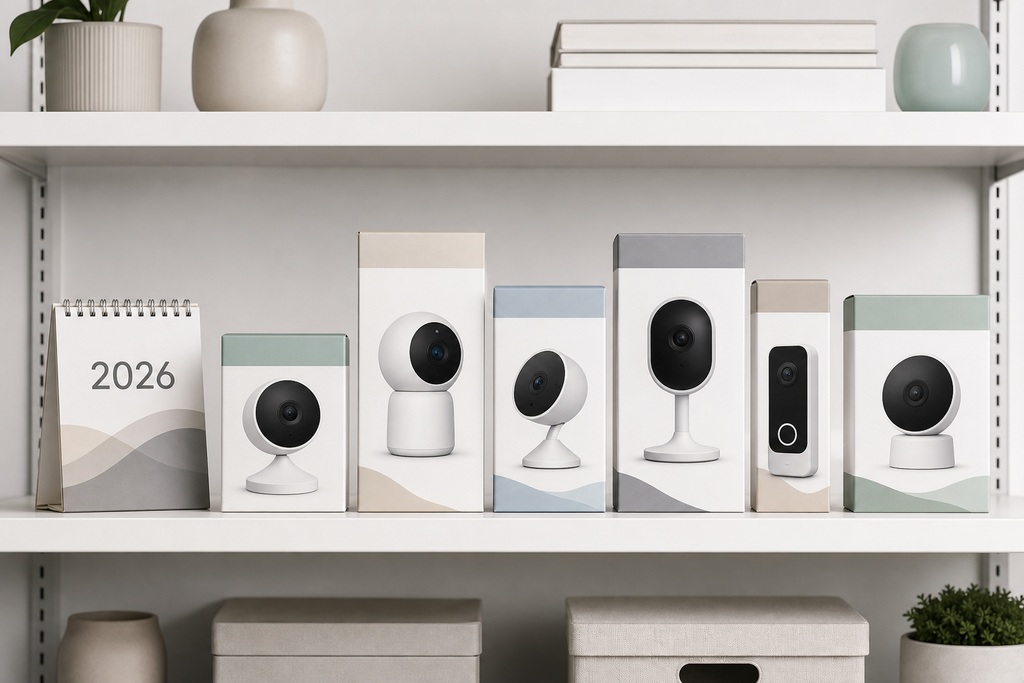
A published spec is not a shipping product. Certified devices trail the specification: app and controller support typically lands 6 to 12 months after a release, and platform updates take several months on their own. The first Matter cameras were projected for the first half of 2026.
| Brand | Committed to Matter cameras? | Expected timing |
|---|---|---|
| Aqara | Yes | First half of 2026 |
| Eve Systems | Yes | Not specified |
| Xthings (Ulticam / Utec) | Yes | Not specified |
Does Matter 1.5 work with my existing devices?
Which smart-home standard fits your setup?
This is a buying direction, not a compatibility guarantee. Choose the conditions you actually have; the exact hub and device still matter.
Ranked recommendation
A standard reduces lock-in; it does not make every advanced feature portable. Confirm the device, controller, and region before buying.
Yes on compatibility, no on a free upgrade. Matter versions stay backward compatible, so nothing you own stops working when your hub moves to 1.5: but your existing gear does not sprout camera or energy features because a new spec exists. Before you rely on any 1.5 capability, check each of these:
- Your current Matter devices keep working after a hub updates to 1.5: no re-pairing, no obsolescence
- An existing camera, plug, or sensor does not auto-gain 1.5 features
- The device maker may need to push a firmware update to enable them
- Your hub or controller must implement the specific 1.5 device type you want
- Not every ecosystem exposes every optional capability of a device type
- Confirm explicit support from both the device maker and your platform: Apple Home, Google Home, Amazon Alexa, or Samsung SmartThings
If your hub sits on last year's firmware, the practical answer is that these features are simply not live for you yet: the spec is ready, your setup is not.
Who should not count on Matter 1.5 yet
Skip the 1.5 conversation entirely if you own no Matter devices: there is nothing to enable, and buying a hub does not create Matter cameras out of your existing ones. Do not upgrade expecting your current camera or doorbell to become a Matter camera; only hardware built and certified for the new device types qualifies, and that started arriving in the first half of 2026. Anyone who came looking for the rumored water valves, irrigation controllers, or pool controllers should stop waiting on 1.5 — those were never in it. And if your priority is a single feature like AI person detection or 30-day cloud history, verify the manufacturer exposes it through Matter rather than reserving it for their own app.
Where Matter 1.5 stands now
Matter 1.5 was quickly refined. Matter 1.5.1, released March 31, 2026, sharpened camera streaming and improved video doorbells, chimes, and intercoms; it added multi-stream video (a camera delivering separate optimized streams for high-res storage, low-res mobile, and AI processing at once), HEIC image support, HLS and DASH streaming, and better pan-tilt-zoom behavior. Matter 1.6 followed on June 17, 2026, which means 1.5 is no longer the newest specification. It remains the release that put standardized cameras, closures, and soil sensors into Matter in the first place — the foundation the later revisions build on.
Common myths about Matter 1.5
Three misunderstandings keep circulating:
- "Matter cameras need a proprietary or custom-API integration." They use the standard protocol over WebRTC, so a certified 1.5 camera works across supporting platforms without a vendor-specific bridge.
- "Closures only cover locks and shades." A modular cluster design combines motion types (sliding, rotating, opening) with panel configurations, covering awnings, gates, and garage doors alongside blinds and drapes.
- "Matter limits what manufacturers can build." The standard sets the interoperable baseline; makers still ship their own apps and premium services on top, including advanced camera features and extended storage.
FAQ
What is the Matter 1.5 specification?
Matter 1.5 is the version of the CSA's smart-home standard released on November 20, 2025 that introduced native cameras and video doorbells, a unified closures category (garage doors, gates, blinds, awnings, smart windows), soil sensors, expanded energy management, and full TCP transport. It stays backward compatible with earlier Matter devices while adding these new device types.
What is the current version of Matter?
As of mid-2026, Matter 1.6 (released June 17, 2026) is the newest version, following Matter 1.5.1 from March 31, 2026. Matter 1.5 is the release that first added cameras, but it is now two revisions behind.
Is 1.5 megapixels good?
That question is about camera resolution, not the Matter 1.5 standard — the two are unrelated. As a resolution, 1.5 megapixels sits below 1080p (which is roughly 2 megapixels), so it is entry-level: fine for a basic live view, but short on detail for reading faces or plates at distance.
When was Matter 1.4 released?
Matter 1.4 was released in November 2024, one year before Matter 1.5. It added solar panels, home batteries, heat pumps, and water heaters, deepening whole-home energy management before 1.5 extended it further.
References
- Connectivity Standards Alliance — Matter 1.5 introduces cameras, closures, and enhanced energy management
- Connectivity Standards Alliance — Matter 1.5.1: enhancing camera performance and expanding device flexibility
- Connectivity Standards Alliance — Matter newsroom release archive